MEMORY MODULE: TAONG DAGAT (People of the Sea)
How do we liberate ourselves from our memories of the sea?
TAONG DAGAT continues my investigation of the sea as both a symbol of the sublime and a mirror of the self, reflecting intertwined histories of labor, identity, and ecological entanglement. Using memory and horizontality as forms of resistance, the exhibition asks how these lingering histories shape our understanding of belonging, movement, and care.
Extending the fictional character of Kerel, introduced in 2013, this module situates the queer Filipino time-traveling seafarer within maritime narratives long framed by normative masculine perspectives. Through Kerel, the exhibition reclaims these spaces to foreground multiplicity, fluidity, and unseen identities, constructing alternative accounts of maritime labor, queerness, diaspora, and postcolonial encounter.
Employing abstraction, minimalism, painting, sculpture, installation, and film, the works merge personal, collective, and ecological histories. Mussel Thinking subtly informs the methodology: resin-cast mussels act as ecological collaborators, evoking cycles of filtration, survival, and interdependence. They articulate porous relations between bodies, objects, and environments, translating material strategies into gestures of care and resilience.
The SOS series, alongside related paintings and films, reflects on the sea’s dual role as both source of life and site of vulnerability. Drawing from wet ontologies, the project attends to the fluidity and entanglement of human and more-than-human life. By weaving together queer narratives, ecological awareness, and historical memory, TAONG DAGAT positions art as an inclusionary space where the sea’s shifting currents can be navigated, questioned, and reimagined.
2024 / Vargas Museum / Philippines
https://coverstory.ph/sea-people-and-their-buoyant-ontology/


Untitled SOS Movement #17 unfolds as a spatial constellation where fragments gather into a quiet, tidal arrangement. Composed of canvas-on-plywood panels, resin casts of mussels and branches, coconuts, jasper stones, aluminum sheets, water containers, a handtruck, mobile devices, and a guitar, the installation hovers between sculpture and site. It operates simultaneously as ship, archaeological field, and open archive, where the detritus of seafaring life appears as if retrieved from a submerged world.
Mussel Thinking quietly informs the work’s structure. Resin mussels act less as symbols than as agents of relation, suggesting cycles of filtration, care, and survival. The installation functions as a porous system in which materials, memories, and ecologies circulate without settling into fixed form. Certain objects index process and memory: a used roller brush bearing traces of the paintings in this exhibition, and a guitar that first appeared in the film Wet Dreams, presented concurrently in TAONG DAGAT. These gestures fold production, performance, and personal history into the work, blurring distinctions between making and remembering.
Drawing on Neferti Tadiar’s notion of “remaindered life,” the installation transforms overlooked materials into an affective archive. It invites viewers to navigate shifting relations between objects, bodies, and the restless waters that bind them.
Title: Untitled SOS Movement #17 ( site specific floor installation)
Medium: canvas on plywood, acrylic stands, water containers, guitar, handtruck, ( branches & mussels) resin sculptures, iPad, iPhone, lube, coconuts, jasper stones, ceramic bowl, aluminum sheet, aluminum bars, Datu Puti vinegar, used paint roller, museum paint tray, and cargo straps
Size: variable dimensions
Year: 2024
This site-activated installation for TAONG DAGAT reimagines the maritime chain through soft sculpture, transforming a symbol of strength, industry, and control into one of vulnerability, permeability, and fluid entanglement. Suspended from the museum ceiling, oversized links made of hand-sewn raw canvas intertwine with seafarers’ overalls and transparent bags containing hybrid objects: shells, wigs, lubricant, slippers, gloves, safety glasses, and “Good Morning” towels. These fragments evoke traces of maritime labor, queer identity, and hidden intimacies, assembling an affective archive of bodies, histories, and desires entangled with the sea. Here, Mussel Thinking emerges not as a literal material gesture but as a conceptual framework. Like mussels filtering the ocean, the installation reflects on how histories, desires, and ecological narratives pass through and cling to objects, bodies, and spaces. It proposes a way of thinking with porousness and interdependence, where meaning is not fixed but continuously circulating, absorbed, sifted, and reimagined.
By subverting material expectations and layering personal, industrial, and ecological artifacts, the installation transforms the chain into a metaphor for relational strength, where connection replaces control. Grounded in queer ecologies and wet ontologies, it invites viewers to inhabit a shifting landscape where the boundaries between human and nonhuman, functional and affective, dissolve, an oceanic space where memory sedimentates, intimacy drifts, and survival persists through entanglement and care
Title: Untitled Sailor #19 black and gray (site specific installation)
Medium: metal hooks, fishnets, canvas (chain) soft sculpture, stuffing, plastic bags, lube, hand towel, canvas jumpsuits with grommets, safely helmet, plastic net, and cargo straps
Size: variable dimensions
Year: 2024

module: wet dreams
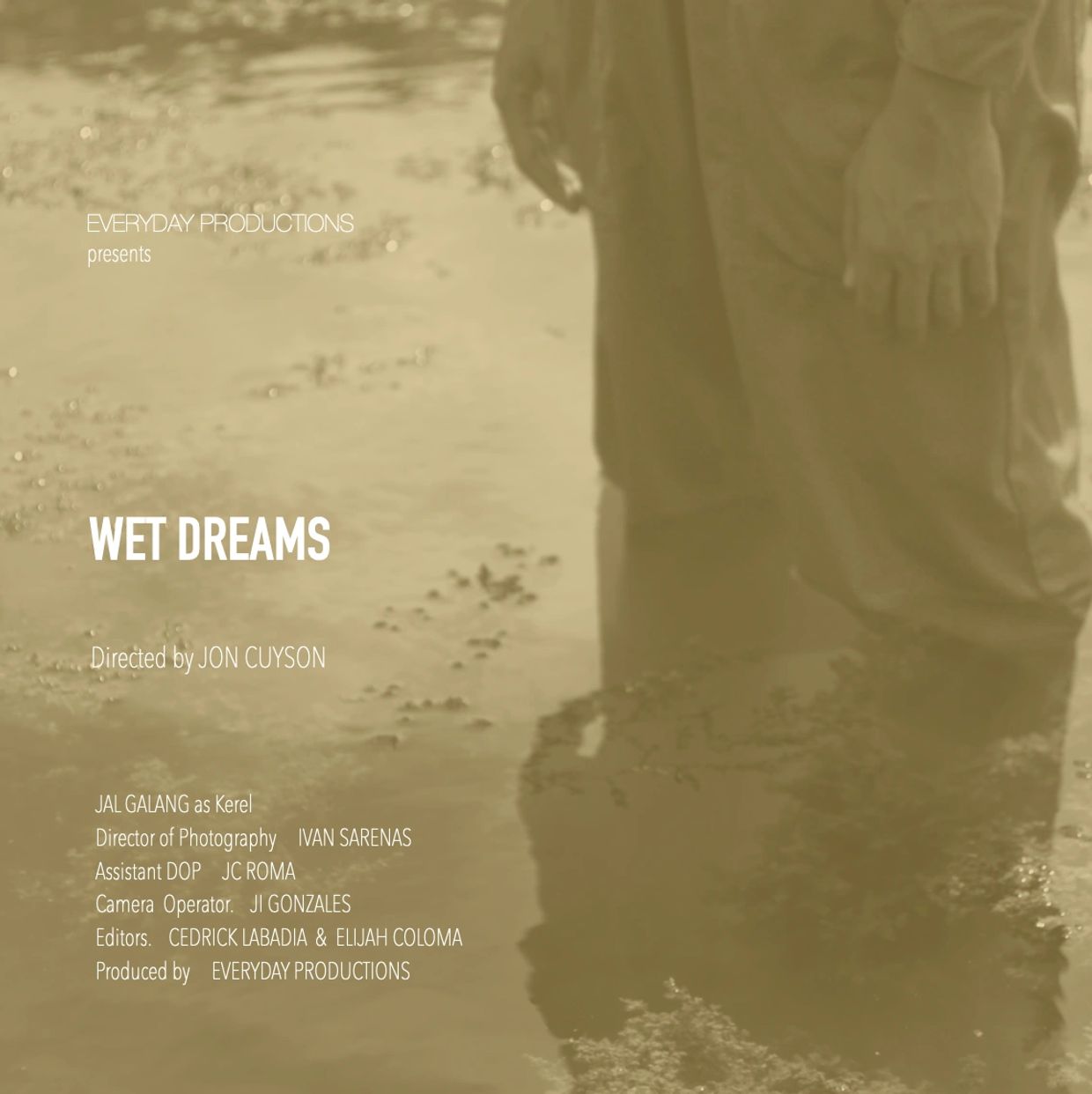
Wet Dreams (2024) is a silent, double-channel experimental film following Kerel, a recurring fictional persona of a queer Filipino sailor, as he strums a guitar atop a rock in the open sea. The black-and-white imagery drifts between dream, memory, and premonition, evoking the mutable nature of maritime space and queer temporality.
The film interlaces original footage with archival materials, including scenes from Badjao (1957) and early maritime documentaries. These fragments converge with surreal sequences: Kerel floating amid submerged plants, mirrored seascapes, shipwrecks, and coral reefs. Guided by Mussel Thinking, the film treats each element as a filtering agent, a site that accumulates, holds, and transmits traces of labor, memory, and ecological resonance, allowing histories, affects, and material presences to cluster like mussels on a rock.
Political rupture enters through found footage of Chinese patrol boats harassing Filipino fishermen, revealing geopolitical fault lines of maritime sovereignty. The narrative then drifts into a mystical cave, zooming into microorganisms, suggesting an ontological meditation on life’s entanglements.
The film concludes with the mirrored image of a solitary seafarer’s helmet marooned on a rock, poised between disappearance and witness. Through archival layering, experimental montage, and Mussel Thinking, Wet Dreams continues my exploration of the sea as a queer, ecological threshold, where soundless gestures, sedimented histories, and ephemeral presences demand attentive, relational, and multispecies modes of sensing and imagining.
Title: Wet Dreams
Medium: Digital Video (black and white finish)
Length: looped
Year: 2024

MEMORY MODULE ACTIVATION: ENCOUNTERS OF DISBELIEF
JON CUYSON
LIZZA MAY DAVID
KAT MEDINA
June 1 - June 29, 2024
ENCOUNTERS OF DISBELIEF
Encounters of Disbelief brings together the works of Jon Cuyson, Lizza May David, and Kat Medina, three artists whose practices move fluidly across painting, sculpture, and installation. The exhibition considers what happens when artworks meet viewers in moments of uncertainty, where recognition fails, and something else, stranger and transformative, emerges.
The title refers to the encounter in art and the “multiple becoming” described by philosopher Gilles Deleuze, who spoke of “thought compelled by the encounter”, where an event interrupts habitual perception, forcing us to think differently. Here, the encounter is imagined as a tidal moment, where perception itself is unsettled, carried into new currents of movement and transformation.
Guided by a methodology akin to Mussel Thinking, the curatorial approach treats the exhibition as a porous ecology. Like mussels filtering water, the artworks absorb, sift, and release fragments of memory, intimacy, and history into the space. Meanings cling and drift, forming temporary attachments before dispersing again. This methodology positions each work as an affective membrane, open to interdependence, where care and relation become central to the act of making and viewing. Whether installed on the wall or the floor, or mediated by technological devices that obscure and reveal images, the works collectively challenge and expand the domain of painting. They question boundaries between surface and depth, color and objecthood, representation and abstraction. By queering modes of perception, the exhibition invites viewers into a space of uncertainty and contemplation, where the familiar slips away and new forms of encounter become possible.
Through abstraction and expanded painting strategies, Encounters of Disbelief provokes dialogue between artist and audience, material and idea, sensation and thought. It suggests that art’s power lies not in offering certainty, but in generating spaces where meaning remains fluid, filtering, sedimenting, and continually becoming.
The exhibition is curated by Jon Cuyson and opens on the 1st of June, 2024 at Galleria Duemila.


MEMORY MODULE ACTIVATION: PROTECT ME FROM WHAT i WANT
BUNNY CADAG
LENA COBANGBANG
JON CUYSON
MARK SALVATUS
PROTECT ME FROM WHAT I WANT
24 October - 16 November 2023
GALLERY 2
The arcades are a center of commerce for luxury items. In fitting them out, art enters the service of the merchant. Contemporaries never tire of admiring them, and for a long time, they remain a drawing point for foreigners. - Walter Benjamin (The Arcades Project)
Underground Gallery presents a group exhibition of four artists whose practice cuts across concerns and disciplines from drawing, painting, sculpture, installation, and performance. Artists, Bunny Cadag, Lena Cobangbang, Jon Cuyson, and Mark Salvatus, will present works exploring the mall as a critical space for creation, consumption, circulation, and confusion. How do these commercial spaces shape and inform artists and vice versa? How are subjectivity and knowledge formed in predetermined spaces meant for transactional engagements? How do artists negotiate artistic production as both consumers and creators?
From the 16th century to the Victorian era, the success of commercial art galleries was made possible by an increasing number of people seeking to own objects of cultural and aesthetic value. The growth in demand for access and convenience contributed to the success of the mall culture worldwide in the 20th Century, including in Asia where the relationship between capitalism, consumerism, and cultural formation has become strongly intertwined. Particularly in the Philippines, the proliferation of malls and art galleries inside continues to be fashionable spaces created and promoted for the perceived needs of everyday life, including leisure, commerce, culture, and by default, myth-making. The exhibition title, PROTECT ME FROM WHAT I WANT, is borrowed from American conceptual artist Jenny Holzer known for her text-based works, constructed from "truisms". Channeling its critique of power, the title could potentially suggest a philosophical and moral dilemma, from what Walter Benjamin may consider as the call for the unsettling effects of the “commodification of things” in the intimate areas of life that include the composition, dissemination, and reception of a work of art in post-materialist values.
The four artists participating in PROTECT ME FROM WHAT I WANT, navigate the complex terrain of artistic production and consumption, actively negotiating their roles as consumers and creators. The artists engage with the varied objects, spaces, and sensory stimuli within the mall and beyond, absorbing influences and ideas that inform their creative process. Simultaneously, as creators, they challenge the established notions of consumption and commercialism through their artistic output. This ongoing negotiation between consumption and creation blurs the boundaries between personal lives and artistic practices, highlighting the porous nature of artistic inspiration.
Curated by Jon Cuyson
Underground Gallery is at Level 2, Makati Square, 2130 Don Chino Roces Avenue, Pio del Pilar, Makati City, Philippines.

MEMORY MODULE: FLOATING WITH EYES CLOSED
Floating With Eyes Closed extends Jon Cuyson’s exploration of abstraction as a site where memory, maritime narratives, and ecological entanglements converge. Through minimal acrylic paintings on raw, unprimed canvas, the works oscillate between illusion and objecthood, foregrounding material presence while opening layered subjectivities. Integrating elements such as tape, foam, louvers, tubes, and “Good Morning Towels,” Cuyson investigates intersections of labor, diaspora, and identity within broader cultural and ecological frameworks. The recurring gray “tubes” evoke ship railings, shifting between representation and abstraction, while the geometric forms referencing towels suggest intimate domestic gestures within industrial maritime settings.
The exhibition also features a raw canvas life vest, a sculptural work blurring the boundaries between painting and objecthood. Serving as both literal flotation device and metaphor for survival, it resonates with the exhibition’s title, exploring tensions between safety and vulnerability, presence and disappearance.
Operating within Cuyson’s Memory Module framework, Floating With Eyes Closed creates immersive spaces where perception, memory, and the rhythms of the sea intertwine. Abstraction here becomes a method of reconfiguring representation, charting connections between materiality, migration, and the fluid intimacies of diasporic life.
2022 / Artery Art Space / Philippines



MEMORY MODULE ACTIVATION: LINE OF SIGHT
Line of Sight
Curated by Jon Cuyson
Nice Buenaventura
Karl Castro
Jon Cuyson
Eric Ramos Guerrero
Galleria Duemila
6 May - June 20, 2023
Galleria Duemila presents the group exhibition Line of Sight, featuring the works of Nice Buenaventura, Karl Castro, Jon Cuyson, and Eric Ramos Guerrero. The Line of Sight or Axis Line is the imaginary line between an observer, spectator, or target. In communication, the line of sight is the direct path from a transmitter to the receiver. In this time of digitization and data accumulation, how are images and messages received and deployed when a clear line of sight is regularly obstructed and manipulated? The ability of works of art to generate nebulous concepts of affect is rooted in the contemporary understanding of the audience and the artist. An image or other visual artwork becomes an object of attention necessary for viewer engagement to produce effect. How do artists negotiate the relationship between maker and viewer? What occurs when that engagement becomes obscured? What strategies do image makers utilize to retain agency? How are subjectivity and knowledge formed without a clear line of sight?
The group exhibition brings together four artists working in diverse media but connected by their interest in the intersection of history and visual culture. Accessing personal and collective memory, they bring complex underrepresented narratives relating to their biography and contemporary socio-political concerns. The artist and curator, Jon Cuyson initiated the underlying idea of the group’s intersecting reflections. The exhibition opens on May 6 and continues until June 20, 2023.
Galleria Duemila is at 201 Loring Street 1300 Pasay City, Manila, Philippines. Online reservations can be made via www.galleriaduemila.com with telephone numbers +63288319990 & +639276294612.

MEMORY MODULE: SOS
SOS situates itself within Jon Cuyson’s ongoing investigation of abstraction, horizontality, and maritime narratives, operating at the intersection of painting, installation, and moving image. Presented at Galleria Duemila, the works deploy repetitive layering, mark-making, and geometric abstraction to construct surfaces that both recede and advance, articulating tensions between presence and absence, stability and flux. Horizontality emerges as a formal and conceptual strategy, functioning as a resistant counterpoint to vertical hierarchies and normative structures, while simultaneously indexing temporality, labor, and affective experience.
The module’s titular reference to the maritime distress signal, SOS (Save Our Ship, Save Our Souls) , operates as both semiotic and metaphoric anchor, situating the abstract compositions within histories of maritime labor, human vulnerability, and ecological precarity. Through the juxtaposition of layered acrylic surfaces, collaged elements, and video imagery of the sea and dripping paint, Cuyson’s work enacts a poetics of memory and contingency, rendering abstraction as a site of contemplative engagement.
SOS exemplifies the conceptual logic of the Memory Module framework: each gesture, medium, and temporal interval functions rhizomatically, generating relational links across projects while mediating between interior and exterior registers of experience. The module thus operates simultaneously as an aesthetic object, a site of critical reflection, and a contemplative archive of human and ecological entanglements.
2022 / Galleria Duemila / Philippines

